Cooling Tower Cleaning Service & Price
Using Anti-Scale, Anti-Rust, and Anti-Algae Chemicals by Runpar Cleaning Team
Cooling Tower — The Heart of Industrial Cooling Systems
A Cooling Tower is the heart of an industrial cooling system. It dissipates heat from process water, ensuring the machinery operates within its optimal temperature range.
Over time, the system naturally accumulates scale, rust, and algae, causing pipe clogging, fill blockage, and reduced heat transfer efficiency. These issues force machinery to work harder, increasing energy consumption, operational costs, and downtime.
To address this, Runpar Co., Ltd. developed the Runpar Cooling Tower Cleaning Service — a professional maintenance program designed to restore full system efficiency, extend equipment lifespan, and ensure safe operation.
Our cleaning solutions are formulated with inhibited chemicals that are safe for steel, copper, and other critical materials in your cooling system.
Cooling Tower Cleaning in Samut Prakan by Runpar Cleaning Team
Professional End-to-End Cooling Tower Cleaning & Maintenance Workflow
Step 1 – Job Intake & Pre-Assessment
Collect system data: brand/model/tonnage, water flow (m³/h), raw & treated water quality, current issues (scale/rust/algae/odor/overheat), last cleaning date
Request documents: P&ID/As-built drawings, SLD (electrical), existing MSDS, and recent water test records (if available)
Schedule a site survey and assign a Safety Gatekeeper for coordination
Phase A – Site Survey & Risk Assessment
1. Kickoff & Safety Induction
Safety briefing, muster point, evacuation route, and hot work/confined space permits
Verify PTW, LOTO, fall protection, and PPE compliance
2. System Condition Inspection
Check fan, drive, belt/gear, motor, coupling, isolators
Inspect fill, drift eliminator, louvers, basin, nozzles, sprinklers, airflow direction
Evaluate structure, leaks, scale/algae buildup, vibration, and abnormal noise
3. On-site Water Quality Test
Parameters: pH, conductivity/TDS, hardness (CaCO₃), alkalinity, iron/copper, chloride, ORP (if using biocide), inlet/outlet temperature
Take photos/videos of damaged areas
4. Risk & Isolation Plan
Drain/bypass/valve isolation, LOTO points, wastewater containment, splash prevention
Assess confined space/high elevation/hot work risks
Deliverables (Phase A): Survey report, cleaning proposal, timeline, safety plan, and wastewater management plan
Phase B – Preparation
5. Job Safety Analysis (JSA) & Toolbox Meeting
Define work steps, hazards, emergency plans, and team responsibilities (RACI chart)
6. Work Zone Setup & Signage
Install barriers, lockout/tagout signs, and “Cleaning in Progress / Do Not Operate” tags
7. Equipment & Chemicals Preparation
High-pressure washer, chemical dosing pumps, brushes, wet/dry vacuum
Cleaning Chemicals:
- Descaler (Anti-Scale Wash): inhibited, non-corrosive formula
- Passivation / Rust Treatment: post-cleaning corrosion protection
- Biocide / Algaecide: remove slime, algae, and bacteria (per MSDS)
Verify PPE and MSDS: chemical gloves, respirators, goggles, suits, harnesses
8. Controlled Shutdown
Power off, apply LOTO, close inlet/outlet valves, and safely drain the basin
9. Protect Electrical Equipment
Cover/seal motors, verify grounding, prevent backflow or spray ingress
Phase D – Mechanical Cleaning
10. Remove Debris & Sediment
Collect leaves, sludge, and sediment from the basin; flush pipelines
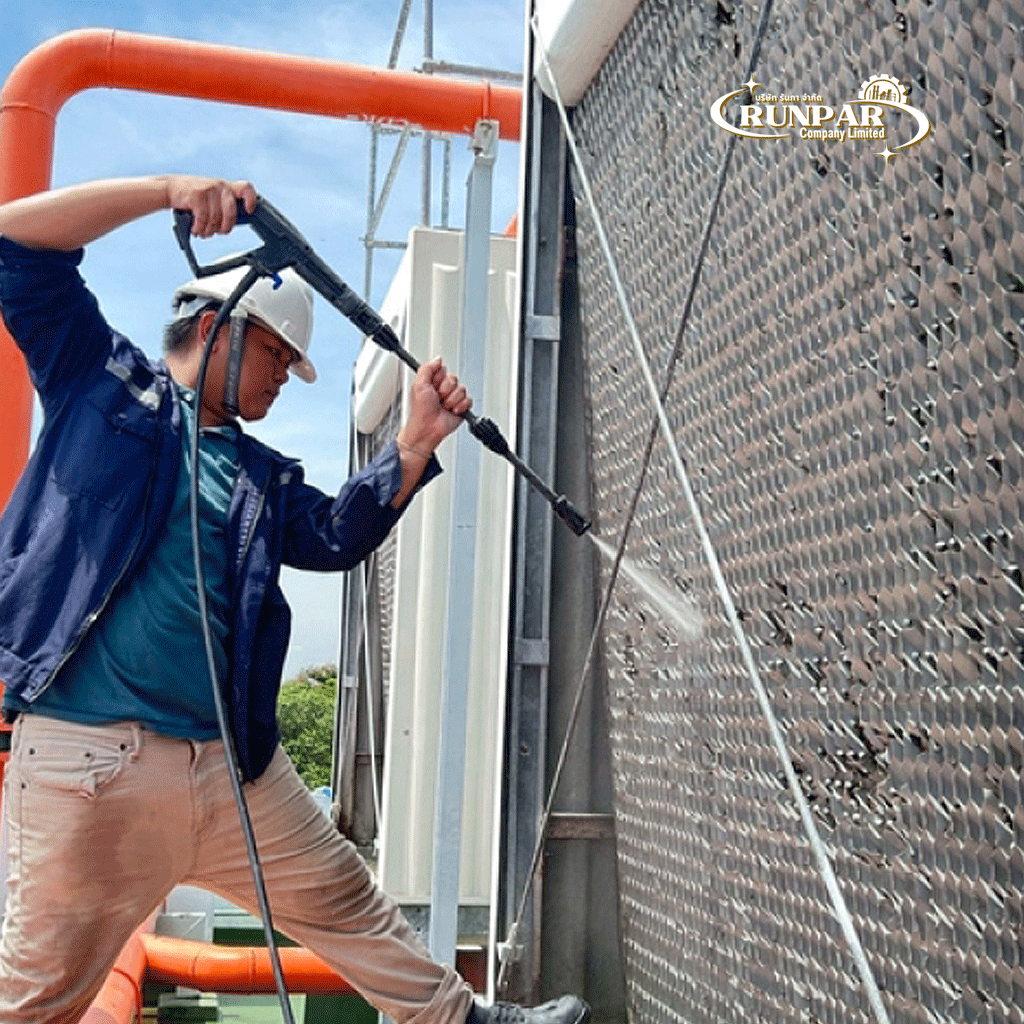
11. High-Pressure Cleaning
Clean fill, basin, louvers, drift eliminator, and casing without damaging structure
12. Component Disassembly & Cleaning
Clean nozzles, spray headers, strainer screens, and covers
13. Minor Repairs & Adjustments
Replace seals, tighten fill clips, lubricate bearings per OEM manual
Phase E – Chemical Cleaning
(Only performed when required; all formulas are inhibited to protect metals)
14. Circulation Cleaning (Soak Method)
Prepare solution at calculated concentration (per MSDS)
Circulate through fill and heat transfer surfaces for defined duration
15. Neutralization & Rinse
Adjust pH to neutral, flush multiple times until parameters normalize
16. Biocide Shock
Apply shock biocide to remove biofilm and bacteria; control concentration and contact time; rinse afterward
Safety Notes: Prevent inhalation/contact, ensure ventilation, use containment trays, and record all chemical usage
Phase F – Reassembly & Commissioning
17. Reassembly & Alignment
Reinstall fill, nozzles, covers, align shaft/coupling, tension belts, torque bolts
18. Water Refill & Flow Adjustment
Adjust nozzles and spray patterns, verify basin level, check drift loss
19. Operational Testing
Measure ΔT (In/Out), water flow, motor current, vibration, and leaks
Record post-cleaning water parameters: pH, conductivity, hardness, ORP/residual disinfectant
Phase G – Handover & Documentation
20. Site Cleanup & Waste Disposal
Neutralize wastewater and dispose per regulation; clean site area
21. Reporting & Records
Before/after photos, water test results, chemical MSDS/LOT, LOTO/PTW records
Inspection checklist and commissioning results
22. Training & Preventive Maintenance Planning
Schedule next cleaning (every 3–6 months, depending on water quality/load)
Weekly/monthly monitoring and key checkpoints
23. Quality Assurance & Warranty
Warranty per contract scope; report issues within 24–72 hours post-handover
KPI Measurement After Cleaning
Reduced outlet temperature / improved ΔT
Lower motor current & power consumption under same load
Stable conductivity and hardness within targets
Reduced drift losses
Zero downtime during first post-cleaning week (under standard conditions)
Customer Pre-Work Checklist
✅ Approve PTW/LOTO and access permits
✅ Confirm system shutdown, water/power readiness
✅ Identify drain/waste disposal points
✅ Provide system layout (P&ID)
✅ Notify any special restrictions (height/confined space/time limits)
Scope & Exclusions
Included: Mechanical + chemical cleaning, water testing, reporting, spray/level adjustments, area cleanup
Excluded: Major component replacement (fill, motors, gearboxes, fans), structural work, heavy lifting/crane service (quoted separately)
Health, Safety & Environment (HSE Essentials)
Full PPE, LOTO, fall protection, ventilation, and clear signage
Inhibited chemicals to prevent metal corrosion, tracked via MSDS
Neutralize and dispose of wastewater per local environmental regulations
Example Timeline (Medium Tower / One Cell)
Day -1: Survey, quotation, and shutdown scheduling
Day 1 (Morning): Setup, PTW/LOTO, draining, mechanical cleaning
Day 1 (Afternoon): Chemical cleaning, neutralization, rinsing
Day 2 (Morning): Reassembly, commissioning, water testing
Day 2 (Afternoon): Handover, training, report delivery
Contact Our Expert Team
Runpar Co., Ltd. 72 Soi 1, Srisamut Road, Paknam Subdistrict, Mueang Samut Prakan, Samut Prakan 10270, Thailand 📞 Tel: +66 (0)82-263-9141 (Khun Pattana / Mixx) 📧 Email: runpar2025@gmail.com 🌐 Website: www.runpar.co.th
Our Work Gallery
Real cleaning process examples by our professional team